
“Sometimes all of our thoughts are misgiven.”
Led Zeppelin

Illisions of Meaning is a text that questions how meaning shifts as we move through love, memories, and time. Starting from a single sentence by Richard Bach, it explores how emotions we once believed to be “eternal” can appear entirely different when viewed from another point in life. This piece does not question the truth of lived moments, but rather examines the fragility of the meanings we attach to them.
***
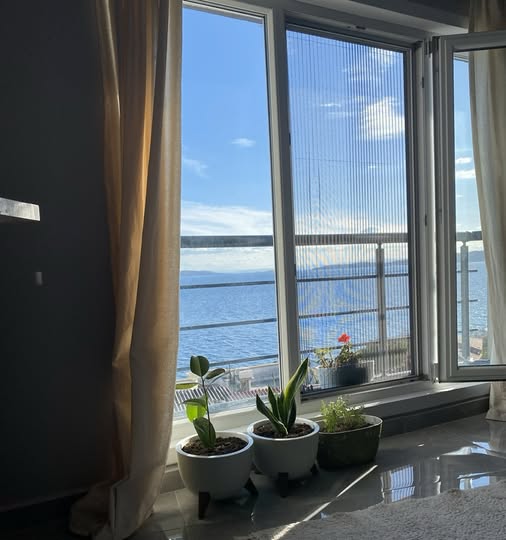
Now, in my attic apartment on the island, I find myself staring—almost involuntarily—through floor-to-ceiling windows at the endless blue formed by the sea, the sky, and the faint silhouettes of distant islands. And I think about how starkly simple this sea and sky are, and how complicated we, in contrast, allow ourselves to become. We assign meanings to things that do not exist; meanings to “things” that were never really there.
Then, suddenly, a sentence by Richard Bach comes to mind. A single sentence of his—just one—feels like a summary of an entire life. In The Bridge Across Forever, Richard writes at length about finally finding, in his forties, the love of his life, his soulmate. He describes how he had managed to live without her until then, how they completed one another, how he would have become a miserable man had he never met her—though such a possibility did not exist, because they were two souls who had been together since eternity, and who finally found each other in this lifetime, destined to remain together forever. You finish the book intoxicated by the idea that such a magnificent love exists, carried by the hope that perhaps one day, you too might find it.
That book was published in 1984. The extraordinary love it presents, which filled readers with hope, ended in divorce in 1999.
A year later, Richard sailed into a new love—and later, into others.
In the 2010s, while answering readers’ questions on his website, he was repeatedly asked the same thing:
“What happened to that magnificent, spiritual love you wrote about in that novel?”
His answer—and the sentence that etched itself into my mind—was this:
“I wish I had added a note at the end of that book saying: ‘Everything written here may be wrong.’”
Richard is now 89 years old, and in photographs I see how he looks at the woman he married in 2020—with what he again calls an eternal love. Another “forever.”
So was the great love in his novels a lie?
No. It was real—down to the deepest layers of his soul, to the very chromosomes of his being. But life, like a train, continues its journey, passing through changing meanings along the way.
I kept looking out the window. A fishing boat was returning; its railings must have been heavy with fish, because seagulls circled above it, following closely.
As I watched, a light suddenly rose from within everything—as if it were radiating simultaneously from every particle. There were no shadows. Whatever existed emerged from the light, only to dissolve back into it. The sky seemed to have forgotten its blue, yet a golden shimmer seeped from within. I felt as though I were looking from a place where time no longer existed. There was no yesterday, no tomorrow—only continuity. For a moment, the sea stood still, like glass. The calm water shifted from blue to silver. It felt as though the surface of time itself had cracked. Everything was both very far away and right here at the same time. A seagull’s cry reached me—but it did not tear through the air; it completed it.
Then, without the light changing, it seemed to take form. The texture of the air thickened; a nearly invisible transparent surface appeared before me, as though passing through a cloud and slowly clarifying. Colors on this surface blended for a while, then began to take shape. On the screen, I saw myself.
Now I was watching myself in a story that felt as though it had been lived in another universe, another dimension.
I am in a whitewashed room. Stairway to Heaven is playing on the radio, on a rainy afternoon in Germany. From the single window of that small, charming studio apartment on Münchener Strasse in Ingolstadt, I watch the rain wash down the glass as I look out over the lush green backyard—green like every square centimeter of Germany. I see the sadness, the quiet melancholy, the feeling of being unable to overcome that impossibility within me. This might have been the final meeting of a relationship that lasted two years, defined by endings and restarts, stretched between Germany and Turkey. I see myself being with him with a bittersweet happiness—and how, now, all of it feels entirely meaningless.
On the screen, I watch how I spent my days while he left early in the morning and returned in the late afternoon. I see how much I missed him. I usually went for walks—through streets that always felt like fairy-tale settings to me, photographing some of the houses as I walked toward the town center. I see myself crossing the bridge over the Danube, browsing shops in the pedestrian zone every German town has, sitting in a café to eat or drink something—missing him deeply through it all—then meeting him and returning home happily together.
I watch a weekend trip to Riedenburg: walking along the river, surrounded by greenery, hiking through forested hills full of caves around that beautiful, typically structured village, listening as he explained the caves to me. Then sitting at one of the riverside cafés, having tea, coffee, cake. On one side, an orchestra played dance music that, to my ears—conditioned by German—sounded almost like a march. I see couples with an average age of sixty-five or seventy dancing, women without partners dancing together, and I watch myself finding it strange—all while thinking that perhaps we would never come together again.
The emotions I felt so intensely flow across the screen in front of me, yet they mean nothing to me now. I perceive, almost indifferently, how meaningless moments that once felt so deep have become.
I see myself angry with him, yet understanding him at the same time. I watch the moment when his carelessness finally overflows my pain and I say, “I’m leaving.” And how, unusually—despite us always speaking English—he says in German, “Don’t go, stay here with me.” And I see how I understood that this did not mean “Because I love you and don’t want to lose you; let our love continue like this,” but rather, “We only have two days left together—let’s not create a scene now; let’s enjoy them, since we won’t see each other again.”
I grieve over the absurdity of my sadness at that moment.
Then the café at Munich airport appears on the screen, where we sat minutes before my departure. I watch myself searching his eyes for any sign that this impossible (was it?) relationship could continue—yet choosing not to ask, so as not to burden him, not to erase even that possibility. And I watch myself realize, with a bitter smile, that if something requires strategy, it does not exist at all. Apparently, I had not understood that yet.
The screen shifts again, showing one of his departures from Ankara. On a warm September day—he had come to spend my birthday with me—I watch us embrace for a long time, his deep blue eyes filling until a few tears spill over. I see how, after he passes through the gate, I feel like an empty sack, unable to move, watching the plane until it becomes a dot in the sky and disappears. And I recognize, now, the profound meaninglessness of that “emptiness.”
Another scene: meeting him at Antalya airport. We had decided to spend New Year’s together in Alanya. I see how I waited over two hours, and how, when he finally emerged, we ran toward each other, embraced, and he lifted me, spinning me in the air. I hear someone who witnessed this say, “That was really worth waiting for.” As I watch us continue to embrace joyfully, I think:
How beautiful. We made each other very happy. If life on this planet has any meaning, it must be this: giving happiness. Being happy. Being good.
Another moment appears: dinners by the window at that tiny table, wine accompanying our meals. He knew that my biggest sign of being tipsy was laughing too much. I watch a night when, walking home from the nearby pizzeria, two glasses of wine sent me into a fit of laughter, nearly collapsing, him trying to hold me, then bursting into laughter himself.
Ah, what a beautiful moment, I think while watching. Because one should always enjoy the pleasure of meaninglessness.
Scenes follow of cooking together in the house we rented in London, setting beautiful tables with wine. It was perhaps the coldest winter London had seen, yet the house was warm. The New Year after Alanya, we met there instead. I see how we bought T-shirts from Hard Rock Café, which I still keep as a memory of him.
Why did I keep it, really? I think. It’s nothing but an old piece of fabric now. It takes up space. Why cling to memories at all?
The images continue to flow. They return to the Stairway to Heaven scene: me looking out the window at the garden, at the rain washing the glass; wanting—but being unable—to hope that this was not our last meeting. Despite Robert Plant’s angelic voice and the extraordinary resonance of the song bringing some relief, I watch tears stream down my face.
Then the images scatter like reflections on water. The sea turns blue again, the sky shines bright blue once more. The moment becomes the most valuable “thing” in the world.
***
“Sometimes all of our thoughts are misgiven.”
Led Zeppelin – Stairway to Heaven

Other stories from same Universe:

