
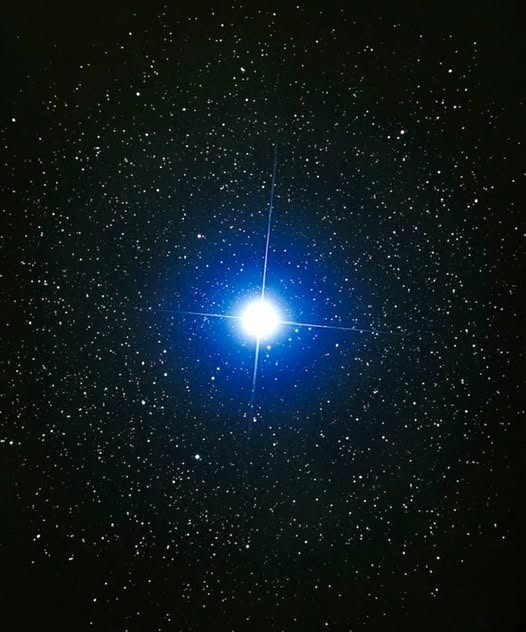
Under the distant light of Sirius, this story moves through goodness, justice, patience, and illusion, wandering between bodies, times, and universes.
It tells of a consciousness that leaves, returns, and is sent back again—not to be rewarded, but to endure, to soften, and to learn the difference between being good and truly bringing goodness.
⸻
An April Night
SEIRIOS – The Scorching One

She did not want to spend her final minutes on this planet feeling cold. She hated being cold. That was why she had bought a sleeping bag—thickly lined with soft fleece, waterproof, a pale phosphorescent blue. It was gentle. Soft. She would drift into a sweet eternal sleep wrapped in warmth and tenderness.
She hated being hungry, too. So she prepared her favorite sandwich: grilled tomatoes, green peppers, and cheese. And tea—there had to be tea. She brewed it carefully, poured it into a thermos, added a slice of orange and a small piece of lemon peel.
She looked around the house one last time. She did not want anyone to say afterward, “It was such a mess.”
She dressed warmly, picked up the sleeping bag, the sandwich, and the thermos, and stepped outside.
It was a cold April night. She breathed in the island’s magnificent scent, sharp and clean in the cold air. Walking through narrow, dim streets, she reached the brightly lit main road. The sound of the waves felt like music in her ears. She crossed the long, empty street and arrived at the cemetery across from the harbor—the most beautiful cemetery she knew, infused with the scent of thyme carried by the sea and the island itself.
She went straight to her grandmother’s grave.
On the stone were the words: “Rest in Light, My Dear Mother.”
Once again, she wondered what her own mother had felt when she had those words engraved. Regret? A wish for forgiveness? It no longer mattered.
This was the grave she had always wanted—on the island, by the sea, in her grandmother’s embrace.
She sat beside it and placed the sleeping bag on the ground. She had grown hungry while walking. She took out the sandwich, opened the thermos, took a sip of the fragrant tea, and bit into the sandwich.
Then she took the pills from her pocket. Two boxes. Exactly one hundred pills.
She swallowed the first one. Took a sip of tea. Continued eating.
The first pill relaxed her entire body instantly, spreading a gentle, delicious calm. It always did. But this time, she took the second, the third, the fifth, the sixth.
Another sip of tea.
She needed to hurry—if she relaxed too much, she might not be able to take them all.
She began swallowing them two or three at a time, washing them down with tea and bites of sandwich. When they were gone, she placed the thermos beside the grave.
She was losing control of her body. She lifted the sleeping bag and struggled slightly to spread it over the grave. One step onto the stone, then the other. She slipped inside the bag and lay on her back.
She was in her favorite place, beside one of the people she loved most, beneath her favorite sky. She looked at it one last time—deep navy blue, clear and radiant, shining through the branches and leaves of tall trees.
Her eyes grew heavy. Her body softened, like a happy lump of warmth. A sweet, cozy sleep wrapped around every cell.
Directly across from her, in the west, the brightest and bluest star in the sky—Sirius, whose name comes from the Ancient Greek Seirios (Σείριος), meaning scorching, burning, because it reappears each year during the hottest days of late July—was the last thing she saw.
And the scorching nature of this planet was the last thing she thought of.
⸻
Eternity
A Cracked Surface of Time
For a moment, it seemed as if another sun was shining everywhere—yet nowhere. Not on the horizon, not in the sea. And still, light rose from within everything, as though radiating from every particle at once.
There were no shadows. Whatever existed emerged from the light and dissolved back into it. Even the sound of the wind was different—neither cold nor warm, but balanced. A silent breath between life and death.
The sky no longer remembered being blue, yet a golden shimmer seeped through it.
She was now looking from a place without time. There was no yesterday, no tomorrow—only continuation.
The sea froze like glass for a moment, its folds turning from blue to silver. The air carried not coolness, but flow. There was no scent, yet a feeling of fresh being. Even the wind passed without speaking.
Time’s surface seemed cracked. Everything was both infinitely distant and right here. A bird’s call sounded—but it did not cut through the air; it completed it.
She looked at herself. She had returned to a light state of consciousness. She had missed this. The weight of the body—its maintenance, its emotions—had been difficult. She had not wanted to feel those emotions anymore. She did not think she would again, at least not for a long time.
Here, she thought with her entire being. She had no head, no brain as on that planet. She could perceive in all directions at once. Slowly, she began to reabsorb this familiar state after the traumatic planetary experience.
She looked around. Where was everyone? Didn’t they know she had returned?
The moment she thought this, a consciousness appeared beside her.
“Because,” it said, “we were not expecting you. You did not endure. You did not wait for your time to end. You left your mission unfinished and returned.”
It was not judgment—only a statement of fact.
“It was very hard.”
“You knew everything there was an illusion,” the consciousness said gently, almost smiling. “And still you could not endure?”
Then the light itself seemed to take form. The texture of the air thickened. Before her appeared a nearly invisible transparent surface, like passing through a cloud that slowly clarified. It was enormous—a screen.
On it were concentric circles opening from within, blinking points of light, a vibrating phosphorescent green rectangle, an orange phosphorescent circle pulsing rapidly, and elsewhere a green phosphorescent triangle vibrating over a checkered surface. Separate movements, the same rhythm. Perfect harmony.
“Couldn’t you have stayed a little longer and embodied unconditional justice?” the consciousness asked, still smiling.
“I couldn’t,” she replied.
“The more ethical, just, and good you are there, the more guilty you become.”
“You know I can’t let you in,” the consciousness said. “You must remain in the Reception Hall. You may change your mind and return to complete your mission.”
The transparent surface moved closer. Now it showed not the planet itself, but her—inside her home, in the place where she had been happiest. Seeing the body she had left behind so vividly startled her at first.
She watched.
The body sat on the couch in a sea-view room, balcony door open, a bowl of nuts in hand, playing a game on the phone while listening to the news on TV. As always, she listened not with emotion but as an observer—proof of how terrible the planet had become. She no longer had any hope it would heal. Humanity had chosen darkness.
Another home appeared. A ground-floor apartment in a new building. The back windows faced the apricot trees she loved—trees she thought she would never lose.
She remembered Tülin’s words:
“I passed by your old building the other day. I couldn’t resist going to look at the back garden. I thought: You may live here now, but we lived this garden at its best. Our happiest days were here.”
Her own reply echoed:
“Are the apricot trees still there?”
A breeze passed through the trees on the screen—not moving leaves, but something inside her. The image faded, returned, layered years upon years. A little girl appeared in the corner of the garden, holding a small container, rolling green apricots in her palm.
Then the image thinned into mist. It didn’t disappear—it withdrew its light. A single line remained. A quiet sum of losses stretching from childhood to now.
She understood then: the planet was calling her not through her past, but through its unhealed voids. Loss was not a place in time—it was a fracture in her consciousness, caught on injustice.
A breeze passed through the apricot trees on the screen. But the breeze moved not the leaves—
it stirred something inside her.
The screen’s light shifted slowly; the colors drained, then returned. It was as if years collapsed into one another at once. In one corner of the garden, there was a small girl—under the spring sun, holding a tiny cup. She rolled the green apricots in her palm. For a moment, the image came so close she felt she could hear the child’s breath.
Then the picture thinned, lightened, became almost vapor.
And then the screen went dark.
It did not vanish—only withdrew its light.
A single line remained, a thin trace—like the silent sum of losses stretching from childhood to the present.
In that moment she understood: the planet was calling her not through her past, but through the holes that had never closed. What she had called loss was not a place in time; it was the fracture of a consciousness caught on injustice. And that fracture had remained where it was for years—never healed.
The screen brightened again. A new image rose—this time the city was darker. Heavy air. A fast walk. A harsh sentence. An unfairness. Everything shared the same tone, the same color. The planet was not showing her childhood—it was showing her every moment in which justice had broken, because she had always been wounded in the same place: injustices others did not even notice left deep marks in her.
“You went, knowing your family, knowing what would happen, knowing the condition of the planet,” the consciousness beside her said, with a smiling vibration.
“Yes,” she answered. “But from here, you can’t understand the body’s pain.”
“It wasn’t your first time,” the consciousness said; she could feel it smiling. “As I told you, I cannot accept your return. If I do, you might not reach the place you imagine right away. You came back without completing your quota of goodness. Returning to complete it is your choice.”
“Did I not complete it?” she asked, startled. “How could that be? I did every positive thing I could. I wouldn’t even take someone else’s place in a line.”
“True,” the consciousness said. “You were meticulous about that. But you treated those who weren’t… very badly.”
“Because,” she said, “everyone—everyone—on that planet should have known how to respect one another.”
“That does not excuse your impatience and intolerance,” the consciousness replied, again with that gentle smile.
She could not answer. The rules were clear. The reason consciousnesses wore bodies and went to that planet was simple: to measure only and exactly how much goodness they would bring back.
The “body” designed for that planet wanted to possess all the planet’s pleasures; consciousness usually melted and surrendered to the body. She had not been able to endure that. She had not been able to tolerate it. And she had not completed her quota of goodness.
All consciousnesses who went to that planet inside bodies would return not with their property and titles, but only with their good deeds—those alone would be carried back and presented.
She had never once looked toward the glitter of that planet. Yet she understood she had not completed her quota, and therefore could not pass. And if she returned again, she might not rise beyond the lower layers.
“Also,” the consciousness added, “because you returned on your own before your time ended, you received a very high negative score. To balance it, if you go back, you’ll have to be much more earnest. Much more tolerant, patient, and you must do as much good as you possibly can.”
She understood something she already knew—again.
If she had a head, she would lower it.
If she had shoulders, they would fall.
If she had a body, she would turn away.
Then the screen suddenly flared again—larger, wider—filled once more with three-dimensional neon geometric forms moving in synchrony: rotating together, opening and closing together, vibrating together. One shape spun on its axis as another pulsed in the same rhythm; another expanded from outside to inside, and another from inside to out. Then the screen calmed. A song appeared inside it:
Let me take you down
‘Cause I’m going to strawberry fields
Nothing is real
And nothing to get hung about
Strawberry fields forever
Living is easy with eyes closed
Misunderstanding all you see
It’s getting hard to be someone, but it all works out
It doesn’t matter much to me
Let me take you down
‘Cause I’m going to strawberry fields
These lines—John Lennon’s—seemed to shout the whole truth directly into her consciousness, but softly, without raising the voice. As if saying:
“The world is too strange to be taken seriously—
but soft enough not to break your heart.”
There is no such thing as “real” there, and living with your eyes closed, caring for none of the illusions, is the easiest path. If you open your eyes wide and watch, you step under a weight that is too heavy. Don’t. Don’t… Because nothing is real.
She looked at the screen again; the lyrics flowed with the song’s gentle curves:
I think I know, I mean… er… yes,but it’s all wrong.
That is, I think I disagree.
I think I know, I mean… er… yes,
but it’s all wrong.
That is, I think I disagree.
She startled as a consciousness. Lennon—decades earlier in that planet’s timeline—had written the place she would arrive at later.
It was as if he had said:
“I think there’s no one on my frequency; they must be either far above or far below—
but it’s not really a problem. It’s not too bad.”
As if he were whispering: go down and live.
“It’s not too bad,” he added.
And then she realized the song continued turning in three dimensions on that enormous screen, as though the lyrics themselves were rotating in space:
No one I think is in my tree
I mean, it must be high or low
That is, you can’t, you know, tune in, but it’s alright
That is, I think it’s not too bad
And nothing to get hung about
Lennon seemed to say: even if you know it’s wrong, even if you don’t agree, even if you can’t find consciousnesses close to your frequency—still, you must be there.
“Don’t obsess,” he said.
“Go down and live.”
“Don’t expect much.”
“Enjoy the taste of absurdity.”
“Savor the pleasure of meaninglessness.”
⸻
A July Day
SEIRIOS / SOTHIS – Awakening
As a consciousness, she gathered her pieces scattered across millions of parallel universes. She turned to the consciousness beside her—
and that one smiled too.
“Alright,” she said. “It seems I don’t have another choice.”
Suddenly she found herself inside a colorful vortex. She passed through a rainbow tunnel—then crashed into something.
With that collision, her eyes opened.
The tunnel vanished, replaced by an enormous, hard, blinding white light. Her eyes hurt.
“What… eyes? Did she have eyes?”
She tried to turn her head away from the light, but her head was like a slab of metal.
She understood: she was in a hospital room.
Then she recognized this world. Its weight, its sounds—its roughness—were familiar. She remembered why she had returned.
“Goodness.”
She was already good, actually. She had never intentionally hurt anyone. She was careful toward nature, toward living beings, even toward non-living things. She would not even throw a stone into the sea—she would wonder whether the stone wanted to go.
Goodness had become, for her, not a behavior but a way of being.
Maybe that was the problem.
Goodness was too natural, too automatic, too unquestioned.
So perhaps it had not been enough.
So there was a difference—unnamed—between “being good” and “true goodness.”
And perhaps that difference lived in effort.
In the places where she struggled.
In her impatience.
In the moments her tolerance ran out.
In every place she felt right.
She understood: what her quota lacked was not goodness—
it was endurance.
And also a more conscious goodness—
like trying to lighten someone else’s burden.
She tried to turn her head again. This time she managed a little. She tried to look around. Everything was blurry except the fluorescent light above.
In the corner of her eye she saw silhouettes approaching. They came and stood beside her. One leaned down and examined her face for a few seconds, then called out:
“She’s awake. She’s awake.”
She tried to speak, but only a rasp came out. Her tongue would not obey. She tried again. Still nothing.
The person beside her said in a sweet voice:
“Okay. Everything is fine.”
She tried to nod.
“You were asleep for three months. You slept a little too long this time. It’s July. Today is the 19th. The island is full—everyone has arrived for the holidays. The sea is wonderful, the air is perfect. Get up as soon as you can and go meet the sea again.”
Three months, she thought.
So it took them that long to convince me.
She closed her eyes again. She wanted to gather strength.
Now she would look at the world through different eyes—less judging, more bringing goodness.
At that very moment, far, far away—in a place between dimensions and universes—while colorful patterns danced in synchrony on a vast screen, the center of the screen opened and images of Ancient Egypt appeared.
There, the Ancient Egyptians were celebrating the reappearance of Sirius—rising again in the sky on July 19, which they believed to be the herald of a new life, beginning from zero.
They called it SOTHIS—Awakening.
Some other stories from the same universe:
What Is Karma and How Does It End?
A good Sirius book is HERE (The Sirius Mystery: New Scientific Evidence of Alien Contact)


